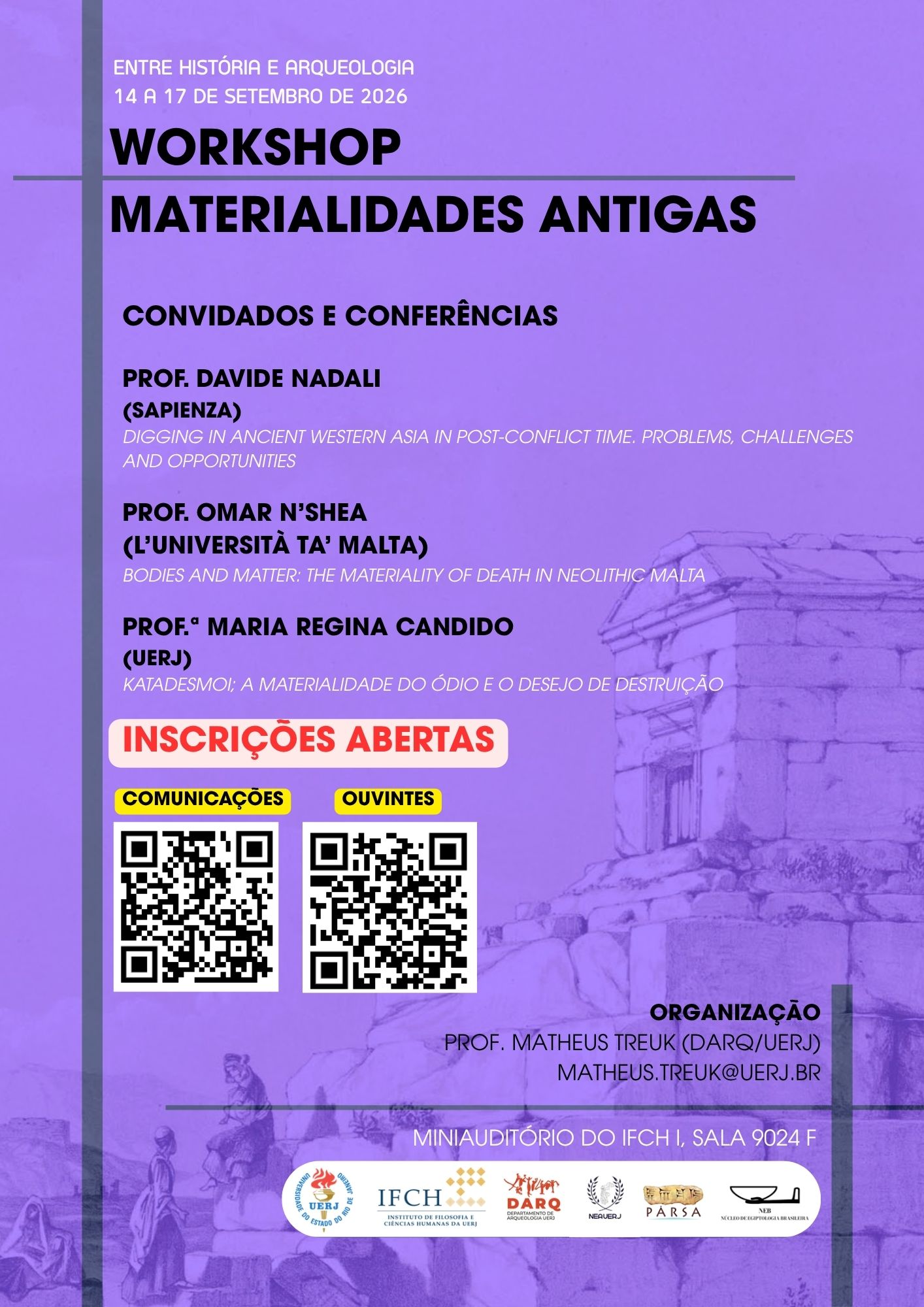
Workshop Materialidades Antigas (UERJ)

I WORKSHOP “MATERIALIDADES ANTIGAS”

Entre História e Arqueologia

14 a 17 de setembro de 2026

Miniauditório do IFCH I (Sala 9024 F)

September 14 to 17, 2026

Auditorium IFCH I (Room 9024 F)

Workshop Materialidades Antigas
Público
Línguas
Formas Plurais
Plural Ways

Resumo

Materialidades Antigas é um workshop organizado pelo Prof. Matheus Treuk, com a colaboração da Prof.ª Dr.ª Maria Regina Candido, no âmbito do Núcleo de Estudos da Antiguidade (NEA), e que visa a abordar as relações entre o mundo material e as sociedades humanas na Antiguidade Mediterrânica e na Ásia Ocidental Antiga. Para esse propósito, palestras de dois professores convidados de Roma e Malta abordarão temáticas relacionadas à arqueologia do Mediterrâneo Antigo e da Ásia Ocidental Antiga, enquanto convidados nacionais irão abordar novas perspectivas teóricas aplicadas à História do Mediterrâneo Antigo. Uma última sessão do evento contará com contribuições de pesquisadores em nível de mestrado e doutorado sob a temática central de nosso workshop. O objetivo é congregar pesquisadores de diferentes níveis de especialização e países, além de aproximar o Rio de Janeiro e a UERJ, em particular, dos polos de pesquisa internacionais, pavimentando caminhos de pesquisa, orientação e colaborações no futuro.

Palavras-chave: Antiguidade; Arqueologia da Antiguidade; História Antiga; Materialidade.


Abstract

Ancient Materialities is a workshop organized by Prof. Matheus Treuk, with the collaboration of Prof. Dr. Maria Regina Candido, within the scope of the Center for Ancient Studies (NEA). It aims to address the relationships between the material world and human societies in the Ancient Mediterranean and Western Asia. To this end, lectures by two invited professors from Rome and Malta will address topics related to the archaeology of the Ancient Mediterranean and Western Asia, while national guests will discuss new theoretical perspectives applied to the history of the Ancient Mediterranean. The final session of the event will feature contributions from master’s and doctoral researchers, centered on the main theme of the workshop. The goal is to bring together researchers from different levels of expertise and countries, as well as to strengthen connections between Rio de Janeiro—particularly UERJ—and international research centers, paving the way for future research, supervision, and academic collaborations.

Keywords: Antiquity; Archaeology of Antiquity; Ancient History; Materiality.


Programa Provisório / Provisional Program

Dia 14 de setembro de 2026 (segunda-feira):

Manhã/Morning: 9h00 às 11h30: Credenciamento [Registration].

Tarde/Afternoon: 13h15 às 14h00: Recepção e Introdução ao Colóquio [Opening] – Prof. Matheus Treuk (UERJ).

14h00 às 16h00: Conferência [Lecture] do Prof. Davide Nadali (Sapienza Università di Roma) – Digging in Ancient Western Asia in Post-Conflict Time. Problems, Challenges and Opportunities

16h00 às 17h00: Sessão de dúvidas e discussão.

Dia 15 de setembro de 2026 (terça-feira):

Manhã/Morning: 9h00 às 11h30: Credenciamento [Registration].

Tarde/Afternoon: 13h15 às 14h00: Coffee Break e Credenciamento.

14h00 às 16h00: Conferência da Prof.ª Dr.ª Maria Regina Candido (UERJ) - Katadesmoi; a materialidade do ódio e o desejo de destruição do inimigo em Atenas clássica.

16h00 às 17h00: Sessão de dúvidas e discussão.

Dia 16 de setembro de 2026 (quarta-feira):

Tarde/Afternoon:

14h00 às 16h00: Conferência do Prof. Omar N’Shea (L’Università ta’ Malta, Valetta) - Bodies and Matter: The Materiality of Death in Neolithic Malta

16h00 às 17h00: Sessão de dúvidas e discussão.

Dia 17 de setembro de 2026 (quinta-feira):

Tarde/Afternoon: 13h15 às 14h00: Coffee Break.

14h00 às 16h00: comunicações variadas - [Título/Title].

16h00 às 17h00: Sessão de dúvidas e discussão.

17h15: Encerramento [Closure].


RESUMOS / ABSTRACTS

Katadesmoi; a materialidade do ódio e o desejo de destruição do inimigo em Atenas clássica

Maria Regina Candido (NEA/PPGH/UERJ)

Consideramos que os katadesmoi, as lâminas de maldição feitas de chumbo e encontradas no cemitério do Kerameikos, Atenas, são a representação material da emoção do ódio e do desejo de fazer mal ao inimigo. No livro Anger and Emotions in Aristotle, de David Konstan, podemos analisar, por meio da citação de Aristóteles, claramente a exposição da possibilidade do extremo do prejuízo: movido pelo ódio, expressamos o desejo de destruir totalmente o inimigo, ou seja, sua morte. O termo “ódio” (o “hate” em inglês) compõe o imaginário social de uma repugnância extrema, muito mais acentuada do que a raiva, pois esta pode ser curada com o passar do tempo (II.4.1382a7-8). Enquanto, para Aristóteles to misein/odiar significa um sentimento que é duradouro, eterno e cessa somente diante da inexistência do inimigo, ou seja, a morte do objeto odiado colocado em tumbas no cemitério.

Palavras-chaves: katadesmoi; inimigo; magia; Kerameikos.


Bodies and Matter: The Materiality of Death in Neolithic Malta

Prof. Omar N’Shea (L’Università ta’ Malta, Valetta)

In Neolithic Malta, death was not an end state but a material negotiation between decay and permanence, absence and representation. In this paper, I explore the materiality of death in Neolithic Malta through the tension between decomposition and permanence. Drawing on bioarchaeological and taphonomic evidence from the Xagħra Circle on the island of Gozo, it contrasts the labour-marked ‘real body’ with the idealized corpulence of megalithic figurines. I argue that death initiated a prolonged deathway in which bodies were actively unmade through disarticulation, fragmentation, and redistribution. I also argue that while decomposition constituted a transformative material process through which individual identity was dissolved into a collective ancestral substrate, figurines materialized a counterpoint, one in which enduring, idealized bodies stabilized and projected a shared identity across time. Together, these practices reveal a dual ontology of the body, one decomposed and dispersed, and the other fixed and amplified.


Digging in Ancient Western Asia in Post-Conflict Time. Problems, Challenges and Opportunities

Prof. Davide Nadali (Sapienza Università di Roma)

The world's archaeological heritage is constantly threatened by armed conflicts, natural disasters, looting, and human-induced landscape transformation. This paper explores the duality between the archaeology of destruction—understood as the study of the traces of past traumatic events—and the destruction of current archaeology, which leads to the irreversible loss of context and information. The paper explores the evolution of protection practices, shifting from static conservation to risk management and cultural first aid strategies. Innovative methods for the recovery and safeguarding of "endangered" heritage are analysed. Through case studies in Syria and Iraq, the paper proposes an approach that combines cutting-edge technologies with traditional practices, highlighting the ability to transform the documentation of damage into a resource for reconstruction and future memory.